Tuesday, January 11, 2011

CFP: Columbia Graduate Conference - The Politics of Form (2/6/2011; 4/22/2011)


The Politics of Form: 2011 Graduate Student Conference
Columbia University Nineteenth-Century Colloquium
Friday, April 22th, 2011

Keynote Speaker: Caroline Levine

In recent years, Victorian studies have seen a resurgence of interest in literary form and formalist criticism. However, these renewed formal interests do not represent a simple swing of the critical pendulum. Rather than retreating from historicism, current critical models seek to amend and complicate New Historicist practices by combining them with examinations of genre, aesthetics, and other formal concerns. Recent work along these lines has been characterized by an attentiveness to form in the service of historically specific claims and an interest in the historical specificity of nineteenth-century literary forms and their cultural meaning. Correspondingly, the conscious significance of literary form and genre to the Victorians themselves is a topic ripe for further examination.
This conference seeks to explore what is particularly at stake for Victorian literary studies in this turn towards form. In particular, we encourage papers on the integration of formalist and historicist praxis, but we also welcome papers exploring the future of either field. Possible topics include but are not limited to:

  • Nineteenth-century literary criticism
  • Aesthetics and aestheticism
  • Social custom, conventions, and etiquette
  • Form and the marriage plot
  • Reading practices
  • Economic and political systems as “forms”
  • Ekphrasis
  • Fetishism
  • Genre theory, theory of the novel
  • Historical fiction
  • Formalism and feminism
  • Queer studies after Foucault
  • Historicism today, formalism today, New Formalism
  • Symptomatic and surface reading; close vs. distant reading
  • Book theory
  • Digitization and Victorian archives
  • Quantitative literary criticism (statistics, graphs, diagrams, charts, etc.)
  • E-texts and reading practices

Abstracts of 300 words should be sent to Anna Clark via email at aec2137@columbia.edu by February 6th. Please bear in mind that final papers should take between 15 and 20 minutes (maximum) to deliver. Proposals for panels (comprising three speakers) are welcome please submit the title and a brief description of the panel as well as abstracts for the individual papers.

CFP: Aesthetic Lives (5/1/11, 9/23-9/24/2011)


"[C]reating themselves out of themselves, and moulding themselves to what they were, and willed to be"

Université Paul-Valéry Montpellier, France
23-24 September 2011

In 1873, citing Hegel’s vision of the Greeks, Walter Pater wrote in The Renaissance: "They are great and free, and have grown up on the soil of their own individuality, creating themselves out of themselves, and moulding themselves to what they were, and willed to be." This Paterian celebration of autonomy and self-fashioning was read with delight, cultivated, and variously implemented by the members of the Aesthetic Movement. Not only did Aestheticism create new objects, but it enabled singular lifestyles to be born. In the last third of the nineteenth century, the facts of existence ceased to be perceived as heteronomous. Life itself was gradually envisioned as a work in progress for an individual at once more aware of his/her freedom as subject and more conscious of changing societal constraints. New lifestyles flourished and novel representations of life emerged. From the Pre-Raphaelite Brotherhood (which immediately preceded the Aesthetic Movement) to James Whistler, Oscar Wilde, William Morris, "Ouida," "Michael Field," or Edward Carpenter, many were those who devoted themselves to practicing and writing about literature and art while evolving a lifestyle which early twentieth-century critics would later identify with the "men [and women] of the nineties."

Fashioning one’s own life became both conceivable and technically and politically possible as individuals gradually ceased to acquiesce in given social configurations of power and value and started interrogating the status quo. Such questioning was often the source of original individual choices and collective interventions such as the creation of clubs, guilds, presses or journals. Within given social, economic and political structures/strictures, of which writers and artists were highly conscious, "Aesthetic" living became an important embodiment of subjective experience and individual experiment.

After our first 2009 trans-disciplinary international conference entitled "British Aestheticisms," our 2011 conference on "Aesthetic Lives" hopes to focus on issues of Aesthetic subjectivity, on the lived experience of Aesthetic individuality or difference, and on original trajectories in the context of Aesthetic practices. How did writers and artists turn their existence into an artwork? What does it mean to found a club, an artistic community, a new journal when one is (or claims to be) an Aesthete? What were the cultural, social, economic or political constraints which hindered or enabled Aesthetic projects, aspirations, and itineraries?

Importantly, the notion of "Aesthetic life" is not meant in the limited biographical sense, but should be taken in the broad sense of a personal negotiation and a carving of one’s chosen itinerary or ethical choices in the context of Aestheticism. What kind of ethics can arise from Aesthetic choices? What are its daily manifestations, practically speaking? What were the obstacles or aporiae encountered by those who followed Pater’s ideas about self-fashioning and life as a work of art? How were these subjective choices received? And how do they anticipate the choices made by the figures of Modernism?

We welcome papers (in French or in English) studying individual artists and writers, specific formal or informal groups, and various arts of Aesthetic living. Descriptive and hagiographic approaches are to be strictly avoided. A selection of papers will be published. Please email your proposal by May 1st 2011 to bncoste@free.fr AND catherine.delyfer@univ-montp3.fr.

Guest speakers to be announced soon.

Monday, January 10, 2011

CFP: Modes of Transport: Travel Writing and Form, 1780-1914 (2/18, 5/26-5/27/2011)


MODES OF TRANSPORT: TRAVEL WRITING AND FORM, 1780-1914
An interdisciplinary conference at King’s College London,
26 & 27 May 2011

Keynote speakers: Mary Beard (Cambridge), Dane Kennedy (George Washington), and Dea Birkett (The Guardian)

There has always been a certain amount of unease and anxiety about how best to mould the quotidian, often repetitious, experience of travel into a digestible, literary narrative. The travel writer cannibalises other modes of literary, geographical, and scientific writing, while simultaneously forging experimental, innovative and dynamic forms in the struggle to represent the heterogeneous and often chaotic experience of travel. It is the aim of this two-day conference to bring together academic researchers and professional travel writers in order to explore the relationship between travel writing and formal innovation in a variety of media across the long-nineteenth century. As Franco Moretti has suggested, "new space gives rise to a new form," and the period 1780-1914 saw the rise of both new technologies of movement and new categories of traveller. We are specifically interested in how new perspectives, networks, and markets enabled by these developments impacted upon literary and media form and how literature in turn affected the ways in which people travelled.

We welcome papers from across a range of academic disciplines, including history, literature, art history, media history, geography and classics. Topics may include but are not limited to:

  • Journals and diaries
  • Scrapbooks and ephemera
  • Souvenirs
  • Postcards
  • Guides and guidebooks
  • Translators
  • Travel journalism
  • Travel in verse
  • Travel on the stage
  • Sentimental journeys
  • Boring journeys
  • Tourists in literature; literary tourists
  • Colonial / postcolonial forms
  • Reading / drawing maps
  • Geography and ethnography
  • Repetition
  • The portable canon
  • Gendered forms

We invite proposals for 20-minute papers from researchers at all stages in their careers. Please send your proposal (max. 250 words) and a brief biography to travelconference@gmail.com by 18 February 2011. Informal enquiries may also be directed to Mary Henes and Brian Murray at the above address.

Supported by the Arts and Humanities Research Institute (KCL) and the Cambridge Victorian Studies Group

http://travelconference.blogspot.com/

Friday, January 07, 2011

CFP: McGill Graduate Conference - Luxuries of the Literary Mind: Readings of Commodity & Privilege (1/14/11; 3/4-6/2011)


17th Annual McGill International Graduate Conference on Language and Literature
McGill University, Montreal
March 4 to 6, 2011

Focus: luxury, privilege, commodity, and consumption in literature, and other texts and cultural artifacts

We invite presentations from all periods and fields of literary study, as well as theatre, film, and cultural studies. Interdisciplinary approaches (e.g., with reference to history, philosophy, science, medicine, economics, art history, religious studies, and other fields) are welcome and encouraged. Potential topics include, but are not limited to the following:

  • Class and social standing.
  • Wealth and poverty, images of excess and need.
  • Human rights (sexual freedoms, disability rights, etc.) versus social privilege
  • The racialization of wealth and status.
  • The politics of pleasure.
  • Iconography, brands and branding, labels, commodity fetishism.
  • Consumer behavior and identity.
  • Binaries of public/private, high/low, male/female, and consumer/producer central to markets and marketing.
  • Literary depictions of shopping, markets, fairs.
  • Imperialism, colonialism, trade, and their effects (e.g., environmental degradation, exploitative labor).
  • Gift-giving, treasure, hoarding.
  • Gender, the body, cosmetic technologies and practices.
  • Camp, ostentation, glamor, performance and performativity.
  • Fashion and sartorial luxuries.
  • Spectacle in film and theater.
  • Cultural and aesthetic decadence.
  • Literature as a luxury (e.g., book-making expenses & practices, middle- & upper-class education as privilege).
  • How has literature shaped or complicated our sense of luxury and commodity?
  • How has literature responded to economic or financial fluctuations?
  • Gastronomy, epicureanism, connoisseurship, and urbanity.
  • Luxury goods and taxes.
  • Lifestyle porn (e.g., luxury travel, culture, or celebrity narratives).

We would be delighted to see Victorianists amply represented in our programme. To facilitate the blind-vetting process, please submit the following to
mcgillconference2011@gmail.com in .doc, .docx, or .pdf form by Friday, January 14, 2011:

  • an anonymous 250-word abstract detailing your proposed paper.
  • a separate cover letter including a brief biographical paragraph.

Keynote Speaker
Dr. George Toles has published extensively on art and ethics in 19th to 20th-century fiction, drama, and film. His book of film essays is titled A House Made of Light (Wayne State UP, 2001), and his screenwriting collaborations with Guy Maddin include My Winnipeg (2007), Brand Upon the Brain (2006), The Saddest Music in the World (2003), and the upcoming Keyhole, currently in production with Isabella Rossellini and Udo Kier. Dr. Toles' presentation will complement what we hope will be a series of engaging and provocative conference panels.

Conference Organizer: Marc Ducusin

Monday, January 03, 2011

CFP: Libidinal Lives: Economies of Desire in the Long Nineteenth Century (4/1/2011)

Edited Collection. Call For Submissions.

Libidinal Lives: Economies of Desire in the Long Nineteenth Century

In his controversial work Libidinal Economy (1974) Jean-Franҫois Lyotard famously remarked "every political economy is libidinal." With this radical pronouncement, Lyotard identified all hegemonic structures as susceptible to the affective ebb and flow of desire. Forming the cornerstone of the new "libidinal materialism," Libidinal Economy, alongside Deleuze and Guattari’s Anti-Oedipus (1972), saw the desiring body as inextricably bound up with economic, political, and fiscal operations. In the decades that followed, a wealth of theoretical work drew on this challenging juxtaposition of the libidinal and the economic. Notably, Lawrence Birkens’s Consuming Desire (1988) postulated a parallel development of sexology and political economy and more recently Regenia Gagnier’s The Insatiability of Human Wants (2000) elaborated on the question of production and reproduction in Victorian Aesthetics.

Building on this important and often contentious body of scholarship, this collection of essays seeks to explore the interrelatedness of desire, sexuality, and economic processes in the literary, scientific, and cultural worlds of the long nineteenth century. Papers might consider the role of libidinal impulses in social and political formations, or question whether desire functions as a cohesive, communal force. They might examine a spectrum of nineteenth-century debates with reference to how they position sexuality as the central and influencing practice in an ideological matrix. In addition they might consider whether we find an undercurrent of competing desires in the patterns of pleasure, production, reproduction and consumption during the nineteenth century, and ask to what extent these desires influenced twentieth and twenty-first century perceptions of the Victorians.

Suggested topics may include, but are not limited to:

  • Production, consumption, creativity, and libidinal impulses
  • Sexual/textual lives
  • Commodity/bodily fetishism and pornography
  • Political/social bodies of desire
  • Gift theory and eroticism
  • Non-"normative" libidinal economies of sensation and pleasure: masturbation, fellation, same-sex intimacy
  • The gothic, cannibalism, the death drive, and desire
  • Imperialist desires and "other" economies
  • Colonial and post-colonial legacies and heritage
  • Theoretical afterlives, ie., Jean-Franҫois Lyotard, Bataille, Deleuze & Guattari, Eagleton, and Queer Theory, etc.

Please send abstracts of 500 words (for chapters of 6,000-8,000 words) along with a CV to Jane Ford and Kim Edwards Keates to jane.ford@port.ac.uk and kim.edwards@liverpool.ac.uk by April 1, 2011. The deadline for completed essays is 1st October 2011. Any queries are welcomed.

Sunday, December 26, 2010

CFP: special number of the Journal of Stevenson Studies: Stevenson, Essayist (2/10/2011)


Stevenson, Essayist: call for papers for a special number of the Journal of Stevenson Studies

Richard Dury (dury@unibg.it) and R-L Abrahamson (rabraham@faculty.ed.umuc.edu) will be guest-editing a special number of the Journal of Stevenson Studies dedicated to "Robert Louis Stevenson, Essayist".

Stevenson's essays are highly regarded and often quoted in discussions of his fiction but little discussed in themselves. We invite brief proposals (with summary CVs of relevant background studies) in any relevant area by 10th February 2011. Selection will be made by the end of February. Manuscripts are to be delivered in September 2011 for publication in mid-2012. Proposals could include the following:

  • RLS and the essay tradition up to 1870
  • The popular essay in the 1870s and 80s
  • 1870s-80s magazines (London, New York) and the market for essays
  • The Cornhill essays
  • The Scribner’s essays
  • RLS’s methods of composition
  • RLS’s essay personas
  • The reputation of RLS’s essays (early years, fame, hagiography, rejection, current views)
  • RLS’s essay style
  • RLS’s essays and Scotland
  • RLS’s essays on America and American topics
  • RLS’s essays on France and French topics
  • RLS’s historical essays
  • RLS’s essays and science
  • RLS’s essays on literature
  • RLS’s essays and the visual arts
  • RLS’s essays and travel
  • RLS’s essays and ethics

Click here for more information on the Journal of Stevenson Studies.

CFP: BAVS Conference 2011: Composition and Decomposition (3/31/2011; 9/1 - 9/3/2011)


Call for Papers: BAVS Conference 2011, University of Birmingham


Composition and Decomposition

The University of Birmingham will be hosting the 2011 BAVS Conference, 1–3 September 2011, on the Edgbaston campus. We invite papers that deal with the conference theme of "Composition and Decomposition" in all its various connotations.

This theme reflects Birmingham’s own nineteenth-century history as the "workshop the world." Birmingham is a city intimately connected with industry and manufacture. However, one of its main exports in the nineteenth century was pens. Our conference thus draws on the double of meaning of composition as both artistic practice and broader industrial process. At a time when the country as a whole, and this city in particular, is reflecting upon the legacy of industrial decline, this conference also invites speakers to think about its inverse, decomposition.

We invite participants to engage with the theme widely and imaginatively. Papers might be on the following:

  • Decadence, decay, and degeneration.
  • Formal composition or simply of what things are made.
  • Putting things together, taking things apart.
  • Waste and recycling; the return of discarded things.
  • Ingredients, inventories, and other types of list.
  • The role of composition in the practice of fine art, music, literature, and drama.
  • Architecture and town planning.
  • Scientific analysis and processes.
  • The material culture of composition, whether draft manuscripts, laboratory equipment, or processes of manufacture.
  • Industrialization, industrial processes, and industrial cultures.
  • The importance of form and formal methodologies.
  • Composition and the press; printing and print culture.
  • The politics of deconstruction, whether as methodology or historical event (clearances, demolition, etc.).

Please send proposals (500 words max) to bavs2011@googlemail.com no later than 31 March 2011. Please direct any queries about the conference to the organizers at the above address.

Please note that the increasing popularity of BAVS as a conference where scholars of Victorian Studies share their research means that, unfortunately, not all offers of papers can be accepted.

The 2011 Conference hosts will select offers of papers according to the criteria of quality, engagement with the Conference theme, and with due regard to accepting papers from a spread of disciplinary areas, to support postgraduate research, and to fulfil BAVS’ commitment to interdisciplinarity.

Click here for more information on BAVS.

Sunday, December 12, 2010

CFP: 2011 Trollope Prize (6/1/2011)


Call for Submissions: The 2011 Trollope Prize

It is with great pleasure that we announce the 2011 Trollope Prize, sponsored by the English Department and the Hall Center for the Humanities at the University of Kansas.

The Trollope Prize will be awarded to the best undergraduate and graduate essays in English on the works of Anthony Trollope. Essays are invited on the topic of "Trollope and His World." Submissions may include essays focusing exclusively on the works of Anthony Trollope; comparative essays on Trollope and other writers; essays examining Trollope's work and career in the larger context of Victorian history, culture and society; historical or literary essays on topics central to Trollope's work and illuminated by his work; or essays on the reception of Trollope's work or on his larger cultural influence.

Beginning in 2011, two prizes will be awarded: one to an essay written by an undergraduate student and one to an essay written by a graduate student. The writers of the winning undergraduate essay will receive a $1,000 award and a hardcover copy of a Trollope novel. The winning undergraduate student's faculty adviser will also receive a $500 award to help support the continued development of curriculum focusing on Trollope's works. The graduate winner will receive a $2,000 award and a hardcover copy of a Trollope novel.

All essays must be received by June 1, 2011. Winners will be announced in August 2011.

Please visit the new website at trollopeprize.ku.edu for more information about the prize, including submission criteria and guidelines.


Thank you,

Lauren Harmsen Kiehna, on behalf of the Trollope Prize Committee at the University of Kansas

Wednesday, December 08, 2010

CFP: Rudyard Kipling: an International Writer International Conference (3/31/2011; 10/21-10/22/2011)

Rudyard Kipling: an International Writer

Institute of English Studies, London

October 21-22, 2011

Keynote Speakers: Amit Chaudhuri and Charles Allen

"Left and right of my writing-table were two big globes, on one of which a great airman had once outlined in white paint those air-routes to the East and Australia which were well in use before my death." - Rudyard Kipling, Something of Myself

Kipling, hailed as "an interpreter of Empire" (Times, 18 Jan 1936), was regarded as a national institution when he died in 1936, and his funeral in Westminster Abbey was attended by the Prime Minister, Stanley Baldwin. His current reputation is many-sided: sometimes condemned as a racist who embodied the imperial mind-set or dismissed as a writer "whom nobody read," he is increasingly both value and criticized for his complex response to the "otherness" and diversity of races and classes in his writing.

This conference, sponsored by the Kipling Society, focuses on the figure of Kipling as an international writer. It seeks not only to re-assess Kipling’s involvement in imperial ideology, but also to examine his interests in wider international affairs and his connections with foreign locations both within and outside the British Empire. The conference thereby aims to re-examine his work and achievement by exploring his diverse roles as an internationalist, and by considering his relevance to our post-modern globalizing world. Papers are invited on, but not limited to, the following topics:

• Travels and travel writing

• Anglo-American relationships

• Anglo-Indian journalism

• War journalism and propaganda

• Inter-colonial networks

• Imperialism and cosmopolitanism

• Kipling’s writing on India, and other colonies

• Dislocation and returning: exiles, immigrants, expatriates

• Islam and other world religions

• Jews and anti-Semitism

• Kipling and Freemasonry

• Englishness and place

• The literature of modern technology

• The sea and sailors

• Postcolonial responses to Kipling

• Kipling’s place in modernism and other international literary movements

• Intertextuality and literary traditions

• The literature of "other" places (France, Scandinavia, Japan, etc.)

Send your proposals of 150-300 words for 20-minute papers to J.E.Montefiore@kent.ac.uk by 31 March 2011, entering your email subject as International Kipling 2011.

Conference Organizers: Professor Jan Montefiore and Dr. Kaori Nagai

CFP: Victorian Futures at the Dickens Universe (12/15/10; 7/29-31/2011)

DEADLINE reminder: "Victorian Futures at the Dickens Universe"

University of California, Santa Cruz

July 29-31, 2011

The Dickens Project invites paper proposals for a conference on Victorian Futures, with keynote speakers Jay Clayton (author of Charles Dickens in Cyberspace: The Afterlife of the Nineteenth Century in Postmodern Culture) and Andrew Elfenbein (author of Romanticism and the Rise of English). The conference will be held at the University of California, Santa Cruz, beginning on the evening of Friday, July 29 and concluding at lunch-time on Sunday, July 31; papers will be allocated to "threads" to facilitate developing conversations of specific themes and topics. Submit 1-2 page abstracts and a short c.v. to Rebecca Stern (stern2@mailbox.sc.edu) by December 15, 2010.

Papers and panel proposals relevant to the theme of Victorian Futures are welcome. Potential topics include, but are not limited to:

  • Progress and its Discontents
  • Prediction, Probability, Risk, Speculation, Gambling
  • Visions and the Visionary
  • Romantic Futures, Victorian Presents
  • Utopia/Dystopia
  • Science Fiction (the "futuristic")
  • Futures that Never Happened (counterfactuals; counterfictions; narratological explorations of tenses future and conditional; the optative)
  • The Birth of the Author (as historical fact, as biographical challenge, as a critical category)
  • Heavens and Hells
  • Victorian Pasts and Presents (and, of course, Futures)
  • Victorian Afterlives
  • Futures for Victorian Studies

Participants in Victorian Futures are cordially invited to spend all or part of the week following the conference in the redwoods of central California at the annual gathering of the Dickens Universe, an international research group devoted to the study of the novels of Charles Dickens and Victorian literature and culture.

The Dickens Universe's study of Great Expectations begins on July 31 and concludes on the evening of Friday, August 5. Confirmed speakers for the week include Andrew Miller, Jonathan Grossman, Kathleen Frederickson, Teresa Mangum, Claire Jarvis, Helena Michie, Joe Childers, and David Kurnick.

Academic participants in Victorian Futures who wish to stay on for the Universe will have the opportunity to sign up for one of three established Working Groups, which will meet Monday through Wednesday (see below). They may also convene their own Working Group or participate in the Dickens Universe's Nineteenth-Century Seminar. Scholars may thus use the week as an opportunity for extended discussion and scholarly exchange, either with established collaborators or with new acquaintances. Academic participants in the Universe will experience its wide range of scholarly and convivial events; they will also have the opportunity to make a twenty-minute presentation about their current scholarly project in the Nineteenth-Century Seminar, which meets four times during the week.

Please consider the following options:

(i) Attend Victorian Futures as a speaker or participant.

(ii) Attend the Universe as a participant, with the option of joining the Nineteenth-Century Seminar. For further information about the Universe, please direct your questions to John Jordan (picasso@cats.ucsc.edu); write to Catherine Robson (Catherine.robson@nyu.edu) to learn more about the Nineteenth-Century Seminar.

(iii) Attend the Universe as part of a working group. Established groups include Victorian Economics, coordinated by Nancy Henry (nhenry3@utk.edu); Victorian Poetry, coordinated by Tricia Lootens (tlootens@uga.edu); and Nineteenth-Century Sciences, coordinated by Rebecca Stern (stern2@mailbox.sc.edu). You may also convene your own group and/or use the lovely Santa Cruz campus as a venue for meeting with established collaborators. For more information about a particular group, please contact the organizer. For more information about working groups in general, please contact Rebecca Stern.

About the Dickens Project: The Dickens Project hosts a conference at the end of each July on the beautiful wooded campus of UC Santa Cruz above Monterey Bay; this event, the "Dickens Universe," traditionally brings together around 200 people to conduct an intensive study of a single Dickens novel.

Of these individuals, roughly half are members of the general public, and half are faculty and students, post-graduate and undergraduate. Thirty two universities are currently members of the Dickens Project Consortium, each sending Victorianist faculty and students to the Universe every year: members include Berkeley, UCLA, Stanford, Indiana, Yale, Princeton, Cornell, Columbia, and NYU in the United States; Exeter, Birkbeck, and Royal Holloway in Great Britain; plus universities in Israel and Australia. The Dickens Project has earned a reputation as a leading research collective for both Dickens and Victorian studies, and, through its development of a range of events for post-graduates (including an annual winter conference for the delivery of their early academic papers), has established itself as a prominent supporter of the careers of junior Victorianists.

Go to http://www2.ucsc.edu/dickens/ for more information.

Sunday, December 05, 2010

CFP: Transport in British Fiction: 1840-1940 (1/15/2011)


Expanded Call for Papers: Transport in British Fiction: 1840-1940 (Collection of Critical Essays)

The editors are seeking proposals for essays to complete a collection of critical essays currently in progress on transport in British fiction 1840-1940. Because of a recent decision to expand the chronological range covered by the volume we are now seeking proposals on:

• Dickens and transport
• Transport in 1840s and/or 1850s fiction, especially trains
• Transport in 1930s fiction

The collection aims to assess transport’s position in literary consciousness during a century of rapid social, cultural, and vehicular change. Essays should focus centrally on the use of transport or forms of transportation in novels, novellas, or short stories during this period and might consider, for example:

• the narrative role of transport
• the contextual or historical picture of transport presented in fiction
• the representation of specific transport vehicles
• transport within the context of an author’s approach to new technologies
• transport and gender
• transport and class
• transport and sexualities

Other approaches to transport in British fiction during this period will also be considered. Proposals are welcomed on single authors or on topics which range across writers, subgenres, or periods of British fiction.

We envisage that completed essays will be 5,600 words long and due in May 2011.

Please email 500-word proposals and a 150-200-word biography by 15 January to BOTH editors: Adrienne Gavin (Adrienne.gavin@canterbury.ac.uk) and Andrew Humphries (Andrew.humphries@canterbury.ac.uk).

Tuesday, November 30, 2010

CFP: Travel in the Nineteenth Century: Narratives, Histories and Collections (2/15, 7/14-7/15/2011)


"Travel in the Nineteenth Century: Narratives, Histories and Collections"
14-15 July 2011
Lincoln, UK

In the nineteenth century, railways made distant locations ever more accessible, the Grand Tour became more and more a pastime of the middle classes, and British imperial expansion brought exotic locales and non-Western cultures ever closer to home. New ways of thinking about and communicating experiences of travel and of interactions with other cultures held a significant influence in various areas of nineteenth-century culture. This period saw an enormous expansion in museums and popular exhibition culture, technological innovations, such as photography and film, as well as the vast growth of a popular press that served to deliver these experiences, images, and objects to an increasingly literate public. This public in turn seemed to possess an insatiable appetite for travel narratives, shows, and exhibitions, both fictional and factual.

This interdisciplinary conference seeks to explore the divergent and complex ways in which travel was understood and communicated in the nineteenth century. Contributors are invited to investigate the depiction and representation of travel in as wide a variety of media and for as wide a variety of audiences as possible. We seek submissions from historians, literary scholars, art historians, anthropologists, and material culture scholars, which illuminate the narratives—popular, academic, private or official—that surrounded travel in the period.

Plenary speakers will be James Buzard (Massachusetts Institute of Technology), Geoff Quilley (Sussex University), and Nicholas Thomas (Cambridge University).

We invite papers on themes such as:
  • The construction of ideas of the real and the virtual or authenticity and distance through travel narratives
  • Different venues for narrating travel, including the domestic, and the way such venues affected the consumption of travel narratives
  • Forms of travelling individuals, such as the missionary, the explorer, the tourist, the connoisseur, or the scientist, and how they were constructed by texts, images, and objects
  • Different audiences for travel narratives – in literature, exhibitions, private patronage of artists, or in museums and private collections
  • How different narratives framed and constructed the moment of encounter with the cultural other in travel
  • The role of technology in enabling new narratives of travel and how narratives of travel described technology
  • Travelling in time as well as travelling in space
We also invite session proposals that map onto the themes listed above. Session proposals should include a brief outline of the session (300 words), as well as three abstracts (300 words each) for the proposed session.

Please send abstracts of no more than 300 words to Kate Hill (khill@lincoln.ac.uk), Laurie Garrison (lgarrison@lincoln.ac.uk), or Claudia Capancioni (claudia.capancioni@bishopg.ac.uk). The closing date for proposals is February 15, 2011.


Wednesday, November 17, 2010

CFP: VISAWUS 2011: "The Vulgar and the Proper: Victorian Manners & Mores" (3/15, 10/13-15/2011)


16th ANNUAL CONFERENCE of the VICTORIAN INTERDISCIPLINARY STUDIES ASSOCIATION OF THE WESTERN UNITED STATES (VISAWUS)


"The Vulgar and the Proper: Victorian Manners and Mores"

October 13-15, 2011

Houston, TX


KEYNOTE SPEAKER: Helena Michie, English, Rice University, author, The Flesh Made Word: Female Figures and Women's Bodies; Sororophobia: Differences among Women in Literature and Culture; Victorian Honeymoons: Journeys to the Conjugal; co-author, Confinements: Fertility and Infertility in Contemporary Culture, and co- editor, 19th-Century Geographies: The Transformation of Space from the Victorian Age to the American Century. PLENARY SPEAKER: Lynn Voskuil, English, University of Houston, author, Acting Naturally: Victorian Theatricality and Authenticity, and essays in Victorian Studies, Feminist Studies, and ELH. Her current project is entitled "Horticulture and Imperialism: The Garden Spaces of the British Empire."


The 16th annual conference focuses on Victorian obsessions with vulgarity and propriety. We invite proposals on manners and mores in politics, culture, society, religion, art, science, economics, rural life, and other Victorian matters of decorum and propriety and what Victorians deemed vulgar, crude or crass. We encourage papers across all disciplines, including (but not restricted to) art history, literature, gender, history of science, history, material culture, political science, performance, life writings, journalism, photography, popular culture, and economics.


By March 15, 2011 email 300-word abstract and 1-page CV (name on BOTH) to: Laurel.Williamson@sjcd.edu.


Download the full CFP here, and click here for more information on VISAWUS.


Thursday, May 06, 2010

CFP: Victorian Epidemics (9/15/2010; 4/29-30/2011)


Victorian Epidemics

Victorian Studies Association of Western Canada
Banff, Alberta April 29-30, 2011

Keynote speaker: Pamela Gilbert, Albert Brick Professor of English, University of Florida

Dr. Gilbert has published widely in the areas of Victorian literature, cultural studies and the history of medicine. Her first book, Disease, Desire and the Body in Victorian Women’s Popular Novels, was published by Cambridge University Press in 1997, followed by Mapping the Victorian Social Body (SUNY Press, 2004) and The Citizen’s Body (Ohio State University Press, 2007), and Cholera and Nation (SUNY Press, 2008).

This international conference will bring together specialists in Victorian art history, history, gender studies, science, and literature to contemplate the theme of disease in Victorian England and its colonies. Papers will address medical and social histories of disease, literary and artistic representations of disease, and disease as metaphor in Victorian culture.

Possible topics include, but are not limited to:
  • Victorian plagues: cholera, TB, venereal disease, influenza, smallpox
  • histories and narratives of disease
  • identity and pathology
  • disease and the body
  • disease as metaphor, languages of disease, contagion, illness
  • disease and colonization, disease and globalization
  • art as disease, mass culture as disease
  • the spread of commercialism
  • visual and literary representations of disease and illness
  • sewers, filth, miasma
  • slums, prostitution
  • health and hygiene
  • representations of illness
  • mental illness
  • imperial anxiety and disease
Please submit a 500 word abstract and short (50-75 word bio) by September 15 to Kristen Guest, Program Chair, kguest@unbc.ca

The conference will take place in Banff, Alberta in the heart of the Canadian Rockies. The town of Banff is surrounded by the spectacular scenery of Banff National Park, which offers excellent opportunities for both hiking and downhill skiing in late April. Banff is approximately one hour from Calgary and is easily accessible by car or air (regular and reasonably priced shuttles are available from Calgary International Airport).

Photo by Flickr user currybet / Creative Commons licensed

Friday, April 30, 2010

CFP: Re-Reading Symonds (June 18 / Sept 11, 2010)

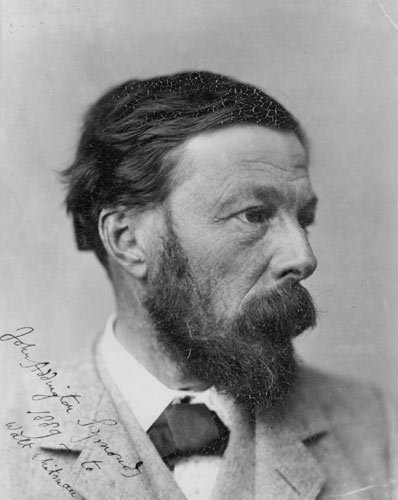
(Re)Reading John Addington Symonds

Saturday 11th September 2010

A one-day conference at Keele University

Plenary Speakers: Howard J. Booth (Manchester) and Hilary Fraser (Birkbeck)


Interest in John Addington Symonds has revived in recent years due to the 1984 publication of his Memoirs (edited by Phyllis Grosskurth), a unique and important record of Victorian homosexuality. He has since become an important figure for historians of sexuality and queer criticism. Despite this resurgence, Symonds has remained a marginalised figure; his participation across multiple academic and creative disciplines is largely excluded from the canon of nineteenth century cultural criticism. This has prompted John Pemble to write: ‘[Symonds’s contemporary readership] kept his reputation alive and most of his books in print until the 1930s; but his prestige faded as they aged and died off.’

Interest in Symonds has grown and diversified during the 2000s. This one-day conference will provide a forum within which to assimilate and evaluate this new and emerging work; it will offer a wide ranging re-assessment of Symonds, exploring his contribution to multiple disciplines and his significance for current fields of academic study.

Papers might address (but are not limited to):

• Symonds and art/art history

• Symonds and Hellenism

• Symonds as ‘man of letters’; literary critic; historian; poet; essayist; translator

• Symonds and nineteenth-century science; sexology; evolution

• Symonds and life writing

• Symonds and travel writing

• Symonds in collaboration

• Symonds and his contemporaries

• Symonds and his critics/advocates

• Symonds and publication; textuality; book history

• Symonds’s reception, reputation and ‘afterlife’

• Symonds and gender/sexuality


Abstracts for 15 to 20 minute papers (c. 250 words) should be emailed to a.k.regis@engl.keele.ac.uk by 18 June 2010.

Informal enquiries should be addressed to the conference organisers: David Amigoni (d.amigoni@engl.keele.ac.uk) and Amber K. Regis (a.k.regis@engl.keele.ac.uk).

This conference is generously supported by the British Association for Victorian Studies.

UPDATE: There's now a conference website: http://sites.google.com/site/johnaddingtonsymonds/

(Image of Symonds is from the Wikimedia Commons.)

Tuesday, March 16, 2010

CFP: Stead2012

W. T. Stead: Centenary Conference of a Newspaper Revolutionary

British Library, London, 16 & 17 April 2012

When William Stead died on the maiden voyage of the Titanic in April 1912, he was the most famous Englishman on board. He was one of the inventors of the modern tabloid. His advocacy of ‘government by journalism’ helped launch military campaigns. His exposé of child prostitution raised the age of consent to sixteen, yet his investigative journalism got him thrown in jail. A mass of contradictions and a crucial figure in the history of the British press, Stead was a towering presence in the cultural life of late Victorian and Edwardian society.

This conference marks the centenary of his death. We aim to recover Stead’s extraordinary influence on modern English culture and to mark a major moment in the history of journalism. In 2012 the British Library will open its state of the art newspaper reading rooms. In Stead’s spirit we will also investigate our own revolution in newspapers and print journalism in the age of digital news.

With Stead as a focal point, we will use aspects of his career to develop multiple avenues into the history of his time and ours. This is not a narrowly focused specialist conference, but one that aims to adopt wide cultural perspectives.

This is a call for expressions of interest. Please send proposals for papers (500 words) or any other suggestions for the conference to stead2010@googlemail.com by the end of July 2010. A full call for proposals will follow in 2011. Further details are here: https://sites.google.com/site/stead2012/

We welcome proposals on the following, in respect of Stead and/or related topics:
  • Stead’s ‘New Journalism’. The Pall Mall Gazette, Review of Reviews and other journals were crucial in the emergence of the modern day broadsheet and tabloid press. Stead provides the opportunity to re-assess some of the key phases in the influence and structures of the press in modern Britain.
  • Stead and technology. Stead was one of the best recorders of the second industrial revolution of the late Victorian period, when telegraphs, gramophones, microphones, telephones, Kodak cameras, wireless telegraphy, horseless carriages, typewriters and new printing technologies transformed everyday life.
  • Stead and the New Imperialism. Stead’s support for English colonies was part of his advocacy for a white commonwealth that would be united through journalism and new communication technologies. We welcome papers on specific elements of Stead’s imperialism, from the support for General Gordon, his opposition to the South African War, to his friendship with Cecil Rhodes.
  • Stead and the Titanic. Rumours about Stead’s manly self-sacrifice and Christian acceptance of death in the last hours of the boat were still being repeated as late as the film A Night to Remember (1958). How was Stead’s death reported? What was his cultural significance in 1912? We also particularly welcome papers on any aspect of the Titanic, especially on the role of newspapers in securing the mythic place the sinking has in our culture.
  • Stead and the occult. Stead tended to report Spiritualism favourably, as part of the non-conformist world of religion. He became active in the movement in the 1880s and tried to foster support for the Society for Psychical Research. He ran the journal Borderland from 1893-7, which reported on ghosts, psychical experiments, hypnotic rapports, astral doubles and messages from the dead.
  • Stead and religion. We aim to trace his early non-conformity, conversion to secular Evangelicism, and his advocacy of a National Church through investigative annuals, such as If Christ Came to Chicago. We also hope to examine his alliance to William Booth, founder of the Salvation Army, whom he helped compose In Darkest England and the Way Out in 1890.
  • Stead and women’s rights. Stead employed women journalists and writers and championed their role in public life. Typically conflicted, this support derived in part from a Christian sense of women’s benign influence on public purity (so that he was disturbed by the overtly sexual New Woman literature of the 1890s). Stead is an exemplary figure to explore the anxieties and contradictions of the gender and sexual liberations of the late 19C.
  • Stead’s ‘invention’ of the tabloid moral campaign. Through his famous campaigns (‘The Maiden Tribute of Modern Babylon’, the relief of General Gordon, British re-armament) Stead interceded into contemporary political and social debates and pioneered this major journalistic genre.
  • Stead and politics. Stead’s political radicalism put him at the centre of events in the 1880s, including the ‘Bloody Sunday’ riots of 1887 and the Match Girl Strike in 1889. He was also a notable campaigner for world peace, speaking at international gatherings in the United States and Russia.
  • Stead and the industry of print. As journalist, editor, publisher, proprietor, with a career that includes regional as well as metropolitan dailies, various monthly magazines, annuals, and a stream of serialised works in part issue, including his ‘Penny Poets’, Stead is a rich node for new research.
  • Stead’s non-conformist, Northern origins. Stead’s career, which includes the editorship of the daily Northern Echo in Darlington for eight years in the 1870s offers an opportunity to investigate the provincial press in the late 19C and today.
  • The continuing newspaper revolution. 2012 is the date when the British Library Newspaper Library moves from Colindale to new, state of the art reading rooms. What will the new digital archive mean for historical research? And what will be the future of print journalism?
Conference Organisers:

Professor Laurel Brake (Birkbeck College)
Ed King (British Library): Head of Newspaper Collections.
Professor Roger Luckhurst (Birkbeck College)
Dr James Mussell (University of Birmingham)

For more information, contact Jim Mussell

CFP: Special Issue of Victorian Poetry on the Globalization of Victorian Meters


Stressing English: The Globalization of Victorian Meters

A special issue of Victorian Poetry (Winter 2011) edited by Max Cavitch, University of Pennsylvania

Thanks to some superb recent conferences and publications in Britain and the U.S., the study of the proliferation of old and new metrical forms in 19th-century poetry in English has shown itself to be anything but ahistorical formalism--not least by emphasizing the historicity of meter's mediation of voices and conditioning of ears. And we can see and hear more clearly now that the metrical history of English poetry is, among other things, an intersectional history of English-speaking nations and regions. Indeed, the last few years have brought major advances in the dialectical framing of the transatlantic "traffic in poems" between Britain and the U.S. Yet the Anglo-American binary continues to predominate, and the more broadly transnational, transformational circulation of 19th-century poetry in English remains largely to be charted. For this special issue of Victorian Poetry, we invite articles that extend this work throughout the Atlantic world and beyond: for example, to the Caribbean and North Africa; to South Asia and Australasia; to Canada and Hawaii; to sub-Saharan Africa and the Middle East. We would welcome submissions on the dispersal of Victorian meters into British provinces from Wales to Bengal; on poetry and the global rise of English; on "world literature" and the global constitution of the sounds of English poetry; on ethnographies of rhythm; on poetic meter and the rhythms of labor and migration; on the metrical dimension of translating poetry from and into English; on the poetry of pidgins and creoles; on the dissemination of English hymnody and other verse forms; on the racialization and deracination of rhythms; on comparativism and the institutionalization of the study of poetry; on prosody and colonialism; on pedagogical uses of meter; on metrical notation, transcription, and recording; on performance, syncretism, and acculturation.
Initial proposals and inquiries, which are welcome but not required, may be sent to the editor at cavitch@english.upenn.edu. Article submissions of five to seven thousand words, prepared in accordance with The Chicago Manual of Style, 15th ed., will be due November 1, 2010, and should also be sent to cavitch@english.upenn.edu.

Deadline EXTENDED: Museum Artworks in the 19thC

This CFP is for a session that Laurence Roussillon and Stephen Wildman will be chairing at the IAWIS conference at Belfast this June 4-6:

Revisiting the Canon: famous museum artworks in the hands and eyes of writers and artists in the nineteenth century

Stephen Wildman, Lancaster University, UK &
Laurence Roussillon-Constanty, Université Toulouse 3, France
In his introduction to Le musée Imaginaire, André Malraux notes that every museum goer knows that even the greatest museums such as the Louvre, the Tate Gallery or the Prado cannot encompass every work of art in the world. However, the very selection they offer calls up a myriad of other art works that are just as worthy of admiration. In a similar way, one can suggest that the artist (whether he/she be a painter, sculptor, writer or poet) who pays a tribute to a famous (and recognizable) piece of art translates his/her reception of the piece of art into another object that is either clearly identifiable - in a classical ekphrastic gesture - or bears a more subtle relation to the original piece of art so that it becomes other. In the margins of the museum canon or as a reaction to it, the transaction from word to image or from image to word thus allows modern artists to write a history of their own that, in the expression found on the Ulster Museum webpage, 'unravels the past to reveal the future'. This session will explore the word-image relation in cases where famous European artworks found themselves as a subject for new creation from the mid-nineteenth century onward.
Full details of the conference can be found at: http://www.adbe.ulster.ac.uk/dwi

All submissions welcome.

Tuesday, March 09, 2010

Mediums, Media, Mediation: Visual Culture & Haunted Modernities (3/26-27/2010)

The 2010 Mellon Symposium at Haverford College brings together scholars from the fields of art history, media studies, and literature to consider the terms “medium,” “media,” and “mediation” in nineteenth- and twentieth-century culture. Speakers will consider perceptions of modern media as haunted, the figure of the Spiritualist medium, and the centrality of mediation to modern theories of representation.

Speakers include Isobel Armstrong, David Peters Corbett, Jill Galvan, Tom Gunning, Dana Luciano, and Pamela Thurschwell.

The symposium is organized by Haverford’s 2008-10 Mellon Post-Doctoral Fellow Rachel Oberter.

Haverford College is located in a suburb of Philadelphia, accessible by SEPTA Regional Rail and Amtrak.

This symposium is free and open to the public; registration is not required.

For a full schedule, speaker bios, and directions, see the symposium website: http://www.haverford.edu/hauntedmodernities.

For more information, please contact
James Weissinger
Associate Director
John B. Hurford ’60 Humanities Center
Haverford College
370 Lancaster Ave.
Haverford, PA 19041
Phone: 610-795-6518
Email: jweissin@haverford.edu

Monday, December 21, 2009

CFP: Reading & Writing in Prison (4-5 June 2010 / Edinburgh Napier U)


Reading and Writing in Prison: An Interdisciplinary Conference

Edinburgh Napier University

4-5 June 2010

This conference aims to bring together scholars, writers and practitioners to share their perspectives on the significance of reading and writing in prisons.

Writing about imprisonment raises key issues that go beyond an immediate concern with incarceration and its institutions, involving notions of subjectivity, citizenship and nationhood. Scholars and practitioners alike have long been arguing that opportunities for reading and writing in prisons can become a dignifying tool for prisoners to re-evaluate and reconstruct their lives, with positive impact on recidivism rates. The conference will act as a platform for exchange about existing scholarship and practice in the area, with the long-term goal of facilitating future research networks, publications and practical projects.

This event explicitly seeks conversations across the disciplines and between ‘theory’ and ‘practice’. Contributors are invited to address reading, writing and imprisonment in any geographical location, in both historical and contemporary contexts. Some of the questions this conference wishes to address are: what defines the genre of prison literature or prison autobiography and how has it changed historically? How do institutional contexts and penal policies impact on reading and writing in prison? What effect do creative practice, prison education and reading groups have on groups of offenders and, conversely, society at large? What is the role of researchers and universities in contributing to debates around narratives of imprisonment, reading and writing in prison?

Possible topics include:
  • Prison literature and prison (auto)biography as a genre
  • The history and publishing context of prison writing
  • Representations of prison reading and writing experiences
  • Gender, class, ethnicity/race and age and their impact on reading and writing in prison
  • Writing and political imprisonment
  • Prison libraries and reading groups
  • Creative writing in prisons: practice and problems
Invited speakers who have agreed to participate (subject to funding) include:
Ed Wiltse on student-prisoner reading groups and the object(s) of literary studies; Gowan Calder and Caspar Walsh on creative writing; Jenny Hartley and Rosalind Crone on prison reading in the nineteenth century; Sarah Turvey on prison reading groups; Bashabi Fraser on the imprisoned writer and the nation.

Contributors should submit an abstract of their proposed paper (250 words) and a brief biographical statement to a.schwan@napier.ac.uk by 1 March 2010.

For further information, please contact the organiser:
Dr Anne Schwan
Email: a.schwan@napier.ac.uk

Image by flickr user alias_archie / CC licensed